







Fluorinated oils are indispensable in microfluidics, with applications across many fields like drug screening, digital PCR, and cell encapsulation. Their biocompatibility, gas permeability, and ability to maintain droplet stability have made them essential for cost-effective and resource-saving experiments.
However, due to growing environmental concerns and regulatory pressures surrounding PFAS (per- and polyfluoroalkyl substances), the production of two widely used fluorinated oils in microfluidics, Novec™ 7500 and Fluorinert™ FC-40, will be discontinued. As a result, industries and research teams are actively seeking high-performance alternatives.
This blog explores the reasons behind this discontinuation, its implications for microfluidic applications, and the reliable alternatives available.
Discontinuation of Some Fluorinated Oils
In a significant shift for industries relying on fluorinated oils for microfluidic applications, 3M has announced it will cease the production of key fluorinated oils by the end of 2025. This decision marks a pivotal moment, as these oils have long been important to various scientific and industrial applications, particularly in droplet-based microfluidic systems.
Why is this Shift Happening Now?
This decision stems from increasing scrutiny of PFAS, often called "forever chemicals" due to their extreme resistance to degradation. These chemicals, which give fluorinated oils their unique properties, have been widely used in various industrial and consumer products, including fluorinated oils in microfluidic applications. However, increasing evidence of their environmental and potential health impacts has led to heightened regulatory action.
Regulatory bodies such as the European Chemicals Agency (ECHA) and the U.S. Environmental Protection Agency (EPA) are implementing stringent measures to address PFAS pollution, including proposed bans and stricter limits, particularly in drinking water. These efforts reflect a global push to mitigate the environmental and health risks posed by PFAS. This movement is also fueled by growing societal and market demands for sustainable practices, with customers, investors, and industries alike prioritizing eco-friendly alternatives.
Novec™ 7500: A Key Oil Under Discontinuation
3M™ Novec™ 7500 is a widely used fluorinated oil known for its non-inflammability and dielectric properties. It has been used in microfluidics for its low toxicity, inertness, and compatibility, as well as in thermal management, cooling pharmaceutical reactors, and semiconductor applications.
Fluorinert™ FC-40: Another Oil Being Phased Out
3M™ Fluorinert™ FC-40 is a highly stable, non-conductive fluorinated liquid widely used in semiconductor cooling, electronics testing, microfluidics, and heat transfer applications. Unlike many other heat transfer fluids, FC-40 maintains its composition over time due to a narrow boiling range, ensuring consistent performance with minimal fluid loss.
Below is a comparison of the physico-chemical properties of Novec™ 7500 and Fluorinert™ FC-40 (data from 3M™), highlighting key characteristics such as density, viscosity, and surface tension. All values are measured at 25°C.
| Oil | Novec™ 7500 | Fluorinert™ FC-40 |
|---|---|---|
| Boiling Point at 1 atm (°C) | 128 | 165 |
| Density (g/cm3) | 1.614 | 1.855 |
| Surface Tension (mN/m) | 16.2 | 16 |
| Molecular Weight (g/mol) | 414 | 650 |
| Refractive Index | 1.29 | 1.29 |
| Viscosity (mPa.s) | 1.24 | 4.1 |
Effects of this Discontinuation
For industries relying on fluorinated oils—such as those in microfluidics—this shift presents considerable challenges. The discontinuation of Novec™ 7500 and Fluorinert™ FC-40 highlights the urgent need for innovative replacements that balance regulatory compliance with the continued advancement of research and industrial applications.
Reliable Alternatives: Emulseo's Fluo-oils
Fluorinated oils play an important role in microfluidics, particularly in droplet-based applications where precise control over tiny liquid compartments is essential. Their unique properties make them an excellent choice for macromolecular engineering, drug screening, and cell encapsulation.
As microfluidic research continues to expand, the demand for reliable fluorinated oils remains high. Therefore, suitable alternatives to Novec™ 7500 and Fluorinert™ FC-40 are needed to ensure the continuity of microfluidic research. Recognizing this need, Emulseo has developed a range of Fluo-Oil alternatives, designed to match the performance of these discontinued oils while ensuring long-term availability.
Fluo-Oil™ 7500: An Equivalent to Novec™ 7500
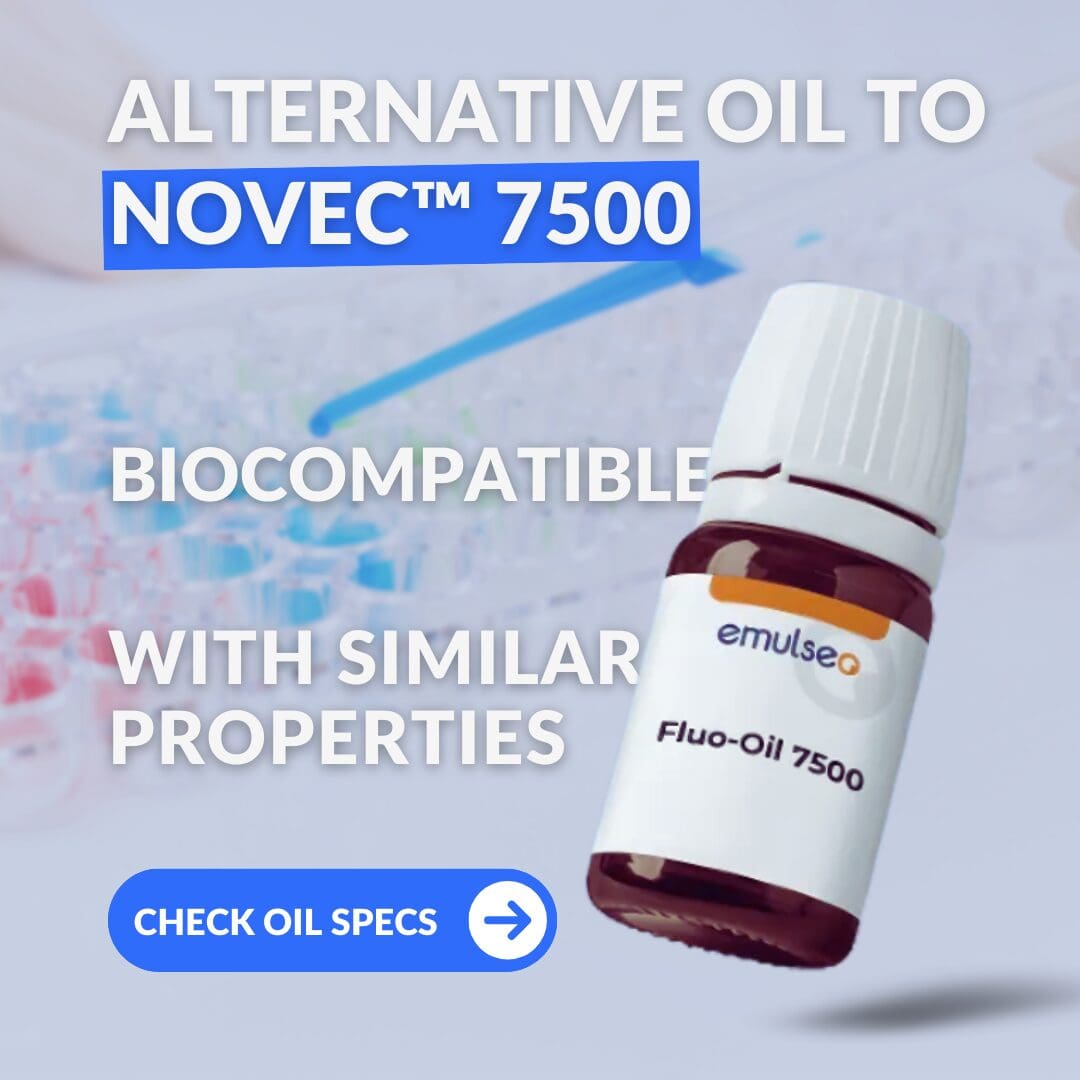
Fluo-Oil 7500, developed by Emulseo, is designed as an equivalent to Novec™ 7500 for microfluidic applications. This fluorinated oil has been carefully formulated to provide stability, biocompatibility, and reproducibility, ensuring consistent experimental results.
With physico-chemical properties closely matching Novec™ 7500, Fluo-Oil 7500 offers the same viscosity, boiling point, and density, making it an easy replacement for researchers and industries.
Fluo-Oil™ 135: A Direct Replacement for Novec™ 7500
Fluo-Oil 135 is developed by Emulseo as a high-performance alternative to both Fluo-Oil 7500 and Novec™ 7500 for microfluidic applications. Engineered with physico-chemical properties closely matching Novec™ 7500, it provides an optimal boiling point, low viscosity, and excellent biocompatibility, ensuring an excellent integration into various microfluidic systems.
A key advantage of Fluo-Oil 135 is its slightly higher viscosity, which helps reduce leakage during experiments compared to Fluo-Oil 7500 and Novec™ 7500. This makes it particularly suitable for long-duration applications, where maintaining droplet stability is critical—even after PCR cycles or extended incubation periods.
Fluo-Oil™ 40: An Equivalent to Fluorinert™ FC-40
Fluo-Oil 40 is produced by Emulseo as an equivalent to Fluorinert™ FC-40 for microfluidic applications. It has physico-chemical properties similar to those of Fluorinert™ FC-40. Formulated to provide stability, biocompatibility, and reproducibility, it ensures consistent performance in droplet-based experiments.
Fluo-Oil™ 200: Ideal for Fluorescence-Based Applications
Fluo-Oil 200 is formulated by Emulseo as an alternative to Fluo-Oil 40 and Fluorinert™ FC-40, offering a stable and biocompatible solution for microfluidic applications. Engineered to maintain reproducibility and reliability, its physico-chemical properties closely align with Fluo-Oil 40, making it a suitable replacement in various experimental setups.
A key advantage of Fluo-Oil 200 is its enhanced dye retention, which significantly reduces leakage of fluorescent markers like fluorescein and resorufin. This makes it particularly well-suited for fluorescence-based assays, such as cell viability studies, where precise reagent retention is essential. However, due to its specific formulation, Fluo-Oil 200 is not recommended for thermocycling experiments.
💡 The transparency, non-inflammability, and biocompatibility of Fluo-Oils make them particularly well-suited for solubilizing Emulseo’s fluorinated surfactants, optimizing droplet-based microfluidic workflows.
🚨 To easily compare the physico-chemical properties of Emulseo’s Fluo-Oils, the tool below provides key data such as boiling point, density, viscosity, and more to support microfluidic applications. Select an oil to display its relevant characteristics.
Other Emerging Alternatives
Beyond Emulseo’s Fluo-Oils, several suppliers have already introduced their own equivalents to 3M’s Novec™ and Fluorinert™ FC-series oils. These alternatives are now available on the market, offering researchers and industries a range of options to replace discontinued fluorinated oils. As the demand for reliable substitutes grows, more companies continue to develop alternatives that ensure stability, biocompatibility, and performance for microfluidic applications.
💡 Conclusion
As the discontinuation of 3M’s fluorinated oils reshapes the market, finding reliable alternatives is essential for maintaining stability in microfluidic applications. Emulseo’s Fluo-Oils offer high-performance replacements, ensuring biocompatibility and reproducibility. With other suppliers also introducing their own equivalents, researchers and industries have multiple options to transition and continue their microfluidics work without disruption.
The table below provides a concise overview of the key physico-chemical properties of Emulseo’s Fluo-Oils.
| Oil | Fluo-Oil 40 | Fluo-Oil 135 | Fluo-Oil 200 | Fluo-Oil 7500 |
|---|---|---|---|---|
| Appearance | Transparent | Transparent | Transparent | Transparent |
| Biocompatibility | Biocompatible | Biocompatible | Biocompatible | Biocompatible |
| Boiling Point at 1 atm (°C) | 165 | 135 | 196 | 129 |
| Density (g/cm3) | 1.85 | 1.72 | 1.79 | 1.61 |
| Flammability | Non-inflammable | Non-inflammable | Non-inflammable | Non-inflammable |
| Interfacial Tension (mN/m) | 16 | 17 | 19 | 16.2 |
| Molecular Weight (g/mol) | 650 | 610 | 870 | 414 |
| Refraction Index | 1.29 | 1.28 | 1.28 | 1.29 |
| Viscosity (mPa.s) | 4.1 | 1.72 | 4.3 | 1.24 |
Stay tuned for upcoming content featuring in-depth explorations of innovative microfluidic techniques, practical solutions to regulatory challenges, and expert tips for optimizing droplet generation processes. Until then, don’t pop your drop 🫧!
📧 If you have any questions or feedback, please feel free to contact us at contact@darwin-microfluidics.com.