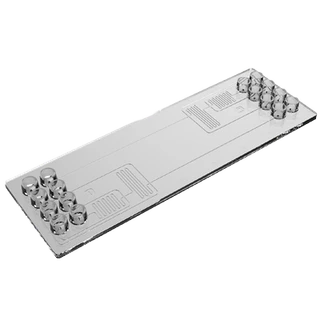
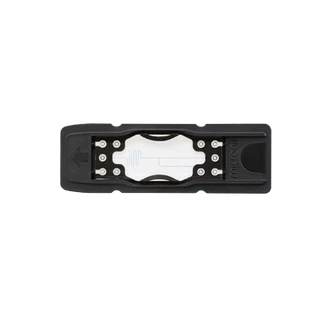
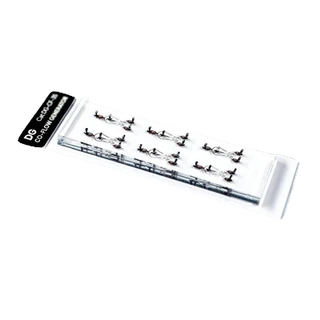
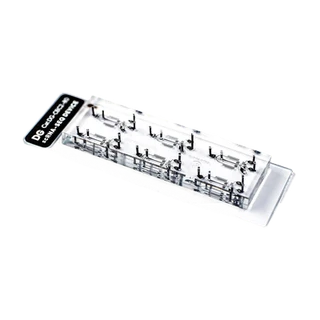
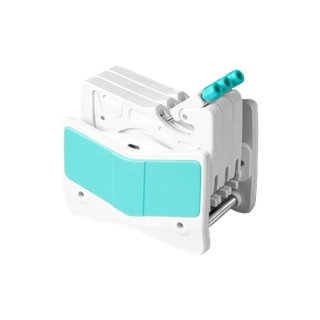
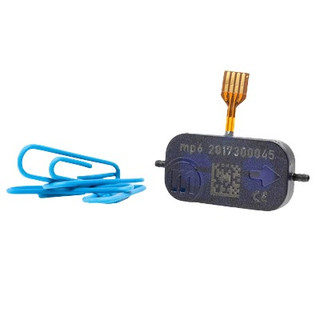
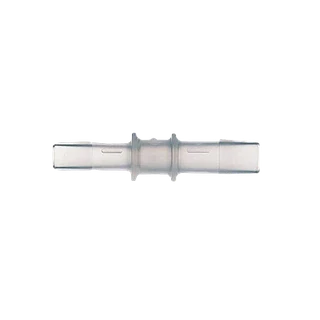
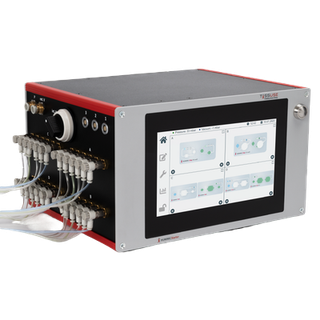
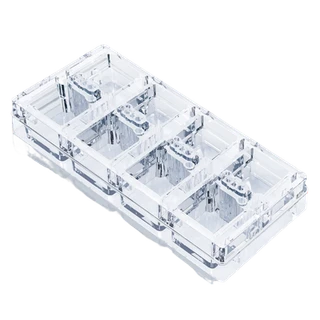
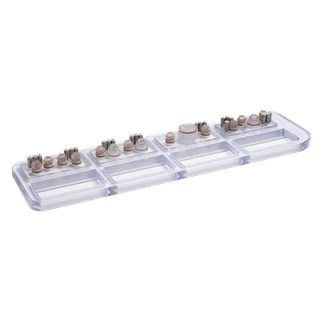
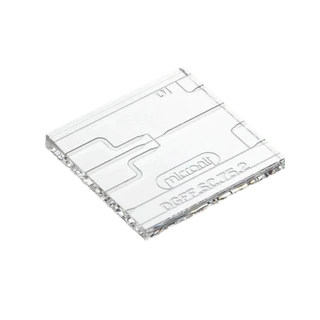
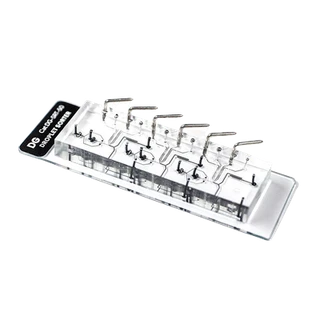
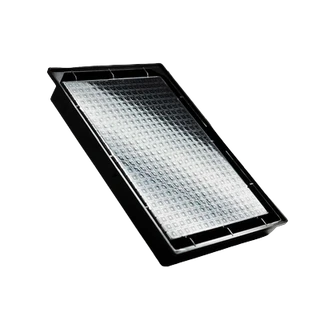
The Cross-Flow Membrane Chip - 3D printing application Fluidic 1754 is a dual-unit microfluidic device designed for advanced 3D cell culture and co-culture experiments. With two independent channels, each unit provides precise control over volume selection and separation via integrated membranes. This chip features easy access to chambers, flexible volume options, and supports direct 3D-printing inside the chamber, making it unique for laboratory applications requiring parallel processing and customizable environments.
General
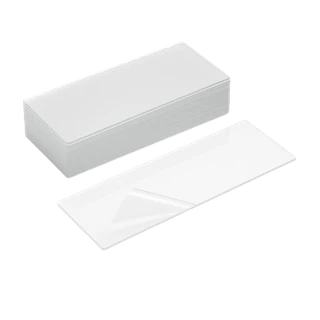
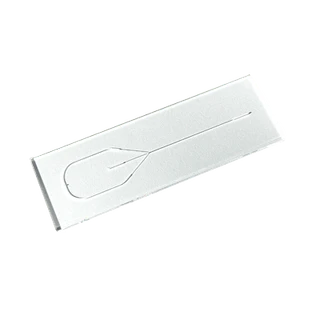
The cross-flow membrane chip Fluidic 1754 possesses two independent units. Each unit features two chambers, separated by a membrane. Each chamber has one in- and one outlet. The chamber above the membrane is open for easy access. A ridge around the top-sided membrane area carries little pillars to support potential 3D-printed structures. Users can print the structures directly into the open chamber and then close the chamber themselves. To close the chamber, the protective foil on top of the chip can be removed, revealing a double sided-adhesive tape. This chip can be ordered with or without pre-cut cover lid (closing substrate). The cover lid enables you to seal the chamber easily. The chip is available with different membrane types, differing e.g. in pore size. To equip the chip with custom membranes, please contact Inquiries@microfluidic-ChipShop.com. Fluidic 1754 can be used e.g. for cell culture experiments, where cells, such as epithelial cells are co-cultured. Attention: Extended exposure to ethanol can impact chip quality and membrane integrity and is therefore not recommended
Features & Benefits
- Dual Independent Units: Enables parallel experiments or processing to increase throughput and experimental flexibility.
- Chambers for 3D-Printing: The open top chamber and internal ridge supports allow direct 3D printing of structures right into the chamber, supporting innovative experiment designs.
- Membrane Variability: Multiple membrane pore sizes (0.2 µm, 3 µm, 8 µm) allow adaptation to different particle or cell separation needs.
- Easy Chamber Sealing: Each chip comes with a removable top foil and optional pre-cut cover lid, making chamber sealing simple and reliable.
- Customizable Components: The chip is available in several variants, and membrane type can be customized for specific research requirements upon request.
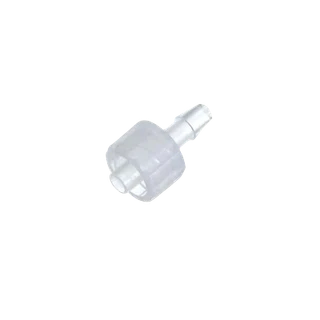
The Cross-Flow Membrane Chip Fluidic 1754 is designed for advanced analytical needs in biology and material science. Its dual-chamber construction supports versatile workflow, such as simultaneous cell culture and molecular separation. Direct access to the chamber enables users to create tailored 3D microenvironments using 3D printing technologies. For researchers, the option to choose from different membrane pore sizes and surface treatments means compatible use with varied sample types and application requirements. The transparent body ensures easy visual control, and the mini Luer interface fits standard laboratory connections. The robust sealing mechanism helps to prevent leaks during long experimental runs.
Applications
This chip is ideal for microfluidic experiments that need strict flow separation, parallel processing, or co-culture of cell types. It fits in labs working on biomedical, cell biology, organ-on-chip, and analytical chemistry studies. 3D structure creation in chambers supports development in tissue engineering and drug testing.
- Cell culture and co-culture experiments
- Organ-on-chip studies
- Separation and filtration of molecules or cells
- Custom 3D testing environments for biomedical assays
Content
1x Cross-Flow Membrane Chip - 3D printing application Fluidic 1754
Specifications
| SKU | CS-10002346 | CS-10002207 | CS-10002257 | CS-10002258 | CS-10002269 | CS-10002270 | CS-10002341 | CS-10002342 | CS-10002343 | CS-10002344 | CS-10002345 |
| Design element | Membrane | Membrane | Membrane | Membrane | Membrane | Membrane | Membrane | Membrane | Membrane | Membrane | Membrane |
| Material | Topas | Topas | Topas | Topas | Topas | Topas | Topas | Topas | Topas | Topas | Topas |
| Material chip body | mcs-COC 16 | mcs-COC 16 | mcs-COC 16 | mcs-COC 16 | mcs-COC 16 | mcs-COC 16 | mcs-COC 16 | mcs-COC 16 | mcs-COC 16 | mcs-COC 16 | mcs-COC 16 |
| Material chip lid | mcs-foil 011 (Topas; 140 µm; Tg 78°C) | mcs-foil 011 (Topas; 140 µm; Tg 78°C) | mcs-foil 011 (Topas; 140 µm; Tg 78°C) | mcs-foil 011 (Topas; 140 µm; Tg 78°C) | mcs-foil 011 (Topas; 140 µm; Tg 78°C) | mcs-foil 011 (Topas; 140 µm; Tg 78°C) | mcs-foil 011 (Topas; 140 µm; Tg 78°C) | mcs-foil 011 (Topas; 140 µm; Tg 78°C) | mcs-foil 011 (Topas; 140 µm; Tg 78°C) | mcs-foil 011 (Topas; 140 µm; Tg 78°C) | mcs-foil 011 (Topas; 140 µm; Tg 78°C) |
| Color | Transparent | Transparent | Transparent | Transparent | Transparent | Transparent | Transparent | Transparent | Transparent | Transparent | Transparent |
| Interface type | Mini Luer interface | Mini Luer interface | Mini Luer interface | Mini Luer interface | Mini Luer interface | Mini Luer interface | Mini Luer interface | Mini Luer interface | Mini Luer interface | Mini Luer interface | Mini Luer interface |
| Surface treatment | Hydrophilized | Hydrophilized | Not treated | Hydrophilized | Not treated | Hydrophilized | Not treated | Hydrophilized | Not treated | Hydrophilized | Not treated |
| Membrane | mcs-membrane 120 (8 µm pores; PET; transparent) | mcs-membrane 156 (0.2 µm pores; PET; transparent) | mcs-membrane 155 (3 µm pores; PET; transparent) | mcs-membrane 155 (3 µm pores; PET; transparent) | mcs-membrane 120 (8 µm pores; PET; transparent) | mcs-membrane 120 (8 µm pores; PET; transparent) | mcs-membrane 156 (0.2 µm pores; PET; transparent) | mcs-membrane 156 (0.2 µm pores; PET; transparent) | mcs-membrane 155 (3 µm pores; PET; transparent) | mcs-membrane 155 (3 µm pores; PET; transparent) | mcs-membrane 120 (8 µm pores; PET; transparent) |
Documentation
Cross-Flow Membrane Chip - 3D printing application Fluidic 1754 datasheet
Click to read more information about Cross-Flow Membrane Chip - 3D printing application Fluidic 1754 information.
Check the chemical compatibilities for this product here:
Topas - Chemical Compatibility Chart