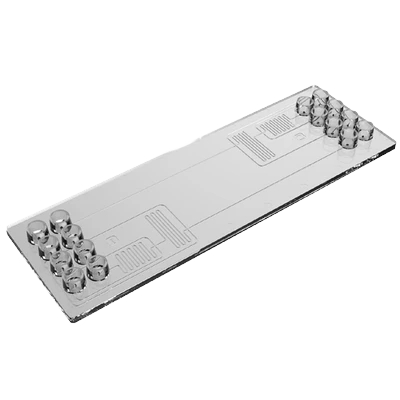
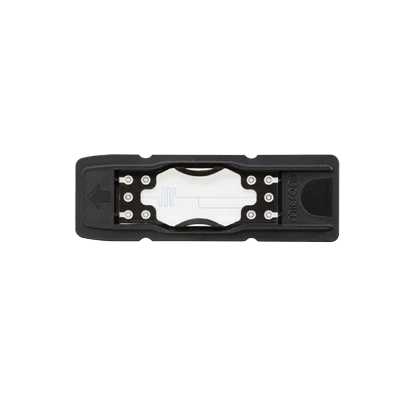
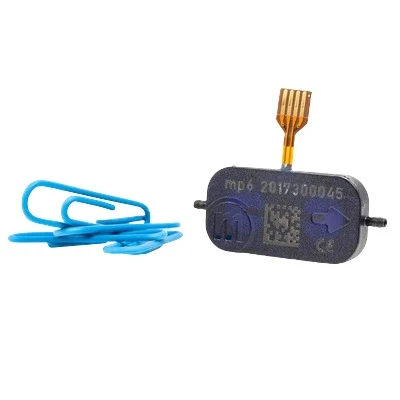
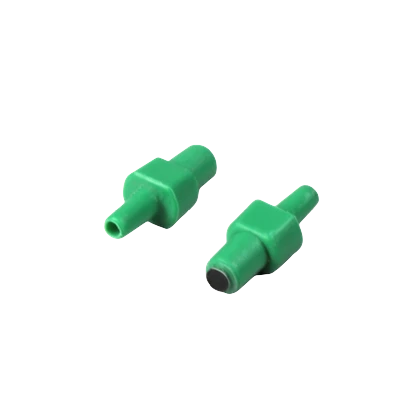
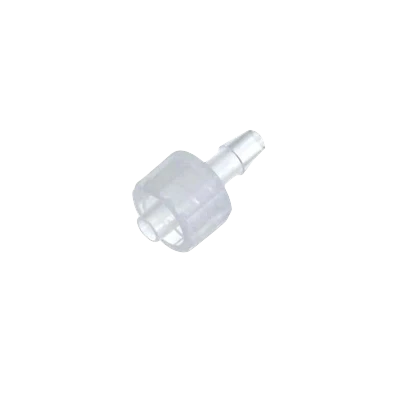
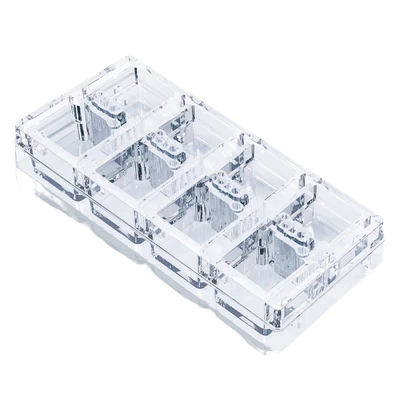
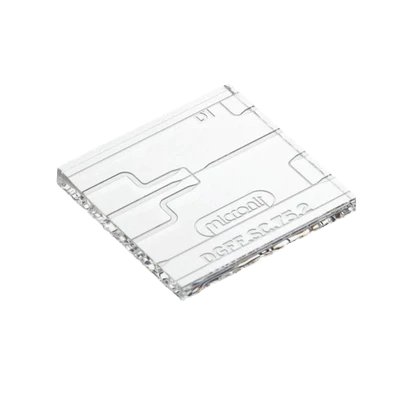
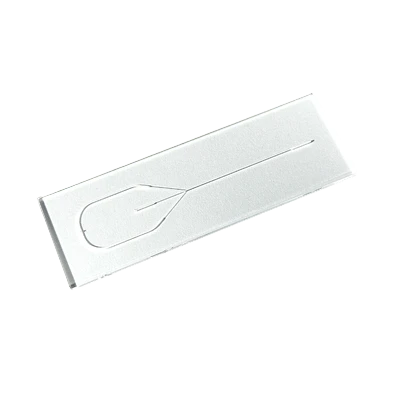
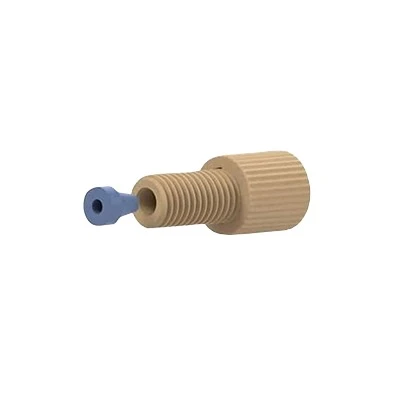
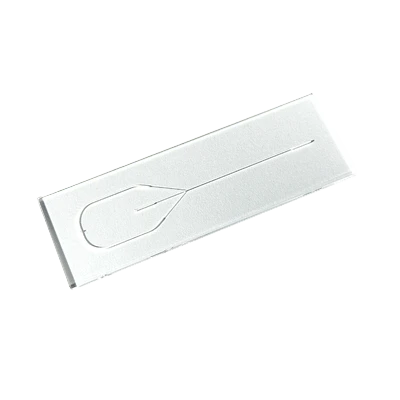
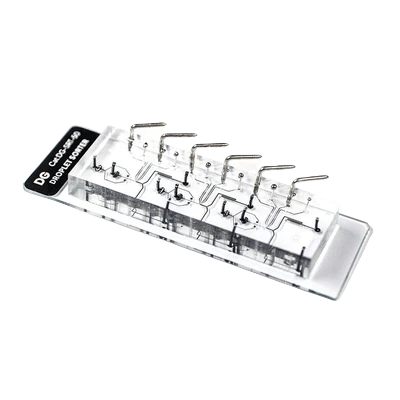
This micromixer chip is a useful tool for mixing liquids through the herringbone-shaped channel optimally. Available with standard 1/4-28 ports or direct through holes, you will be able to connect this chip to your setup in a second!
General
The easy set-up of this versatile glass chip offers a rapid way to mix two fluids by decreasing the necessary length for diffusion and increasing the probability for solute transport between fluids.
This herringbone chip is convenient, cost-effective, and reliable for all your experiments:
- Chemically resistant and optically clear glass
- Standard microscope glass slide size (25 x 75 mm)
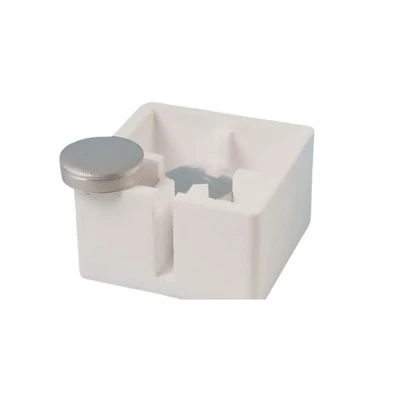
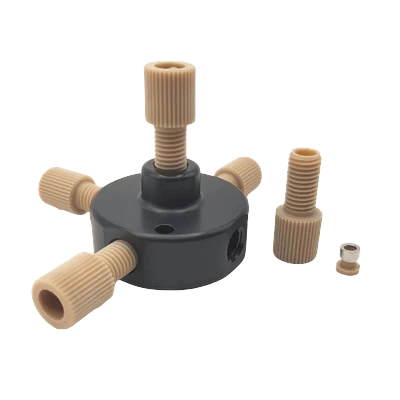
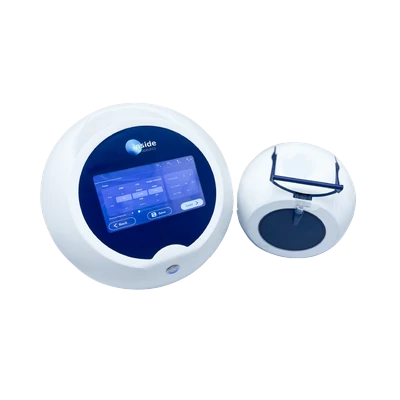
- Through-hole ports: compatible with the LTF Glass Chip Holder
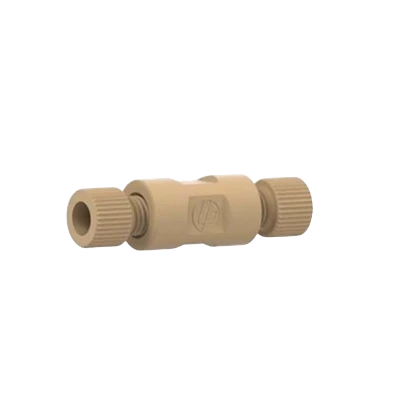
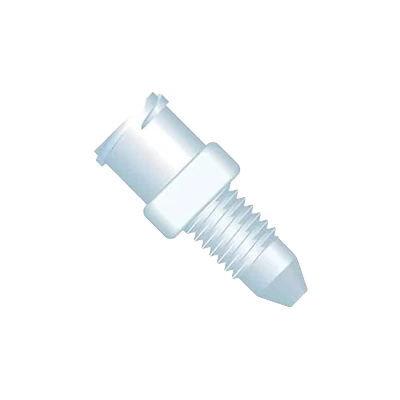
- Standard 1/4-28 UNF ports: easy connection to your system
- Easy handling
Handling instructions
Glass chips can be fragile and must be handled with care.
- Always place the chip on a flat, stable surface when tightening or loosening fittings
- Apply light torque only (max 0.4 Nm) to avoid cracking the ports
- Avoid lifting, tilting, or applying uneven pressure during connection
- It is not recommended to use Teflon tape for additional sealing in a glass thread
- If additional sealing is required, an o-ring can be placed inside the glass thread
- Do not exceed the shock temperature of 120°C
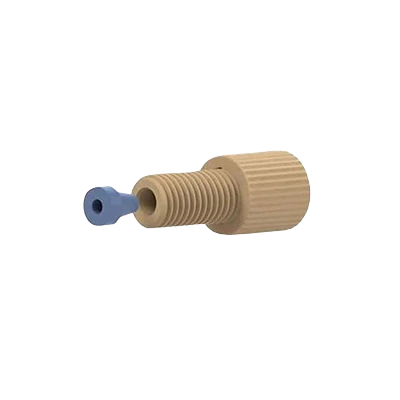
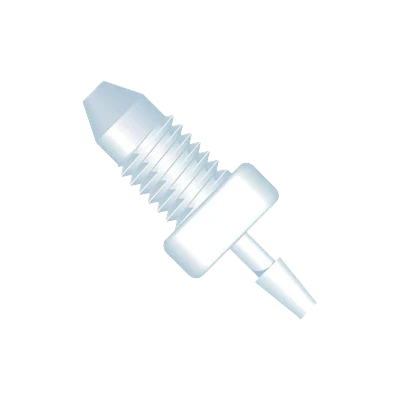
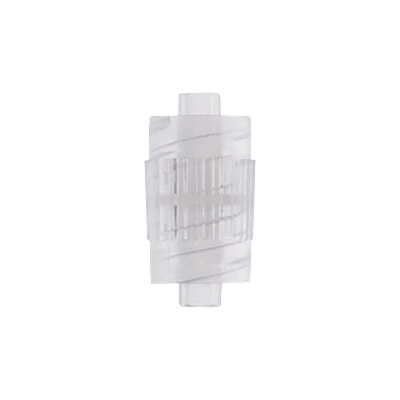
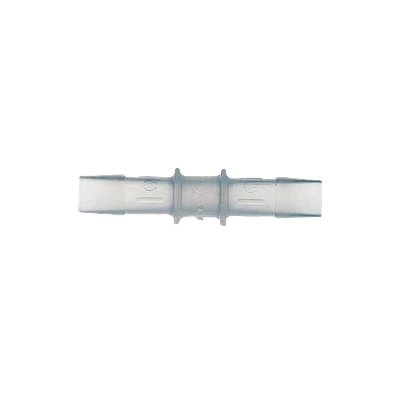
Simply connect the chip to your setup using 1/4-28 fittings for 1/16" OD or 1/8" OD tubing.
Working principle and applications
The Herringbone Mixer significantly accelerates the mixing in the low Reynolds number regime by inducing the formation of chaotic flows.
The microchannel presents a specific pattern with asymmetric herringbone-shaped grooves on its bottom, able to generate helical flow and chaotic stirring for mixing two liquids. Mixing of the fluid flowing through microchannels is important in a variety of applications, e.g., in the homogenization of solutions of reagents used in chemical reactions.
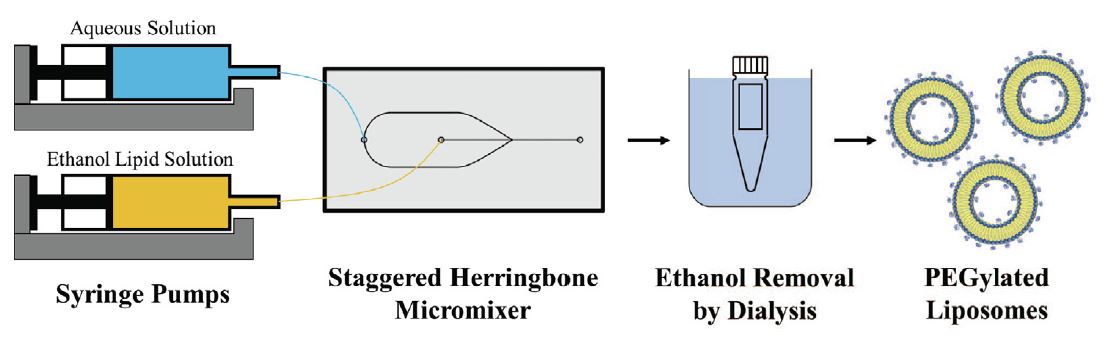
Recently, this Herringbone Mixer has permitted important advancements in the production of liposomes (enclosed phospholipid vesicles). Cheung et al., (Int J Pharma 2019) reported indeed, for the first time, the production of stable and uniform (100 nm) PEGylated liposomes by using our Herringbone Mixer. They studied the effect of different formulations (aqueous media, initial lipid concentration, lipid components, and composition) and processing parameters.
This chip shows higher throughput, faster mixing, and less dilution compared to other microfluidic devices.
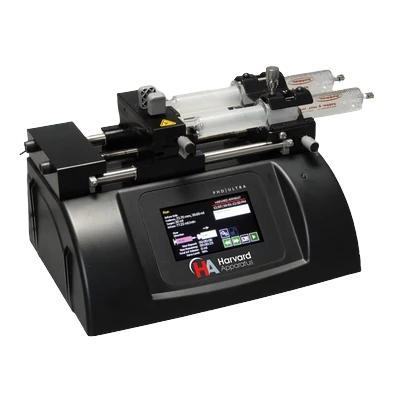
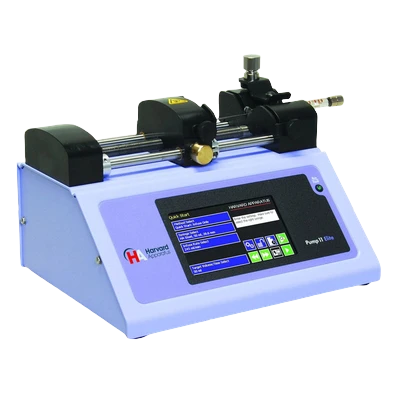
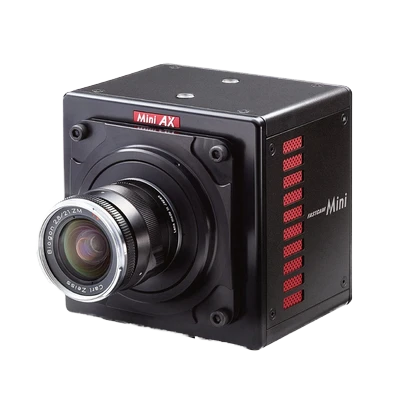
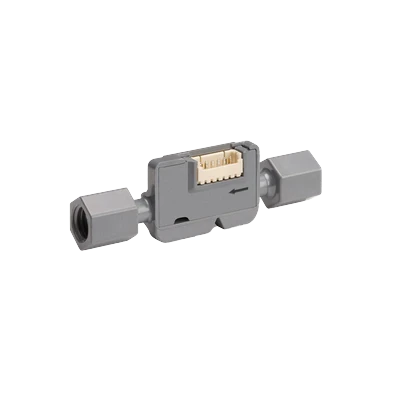
Schematic of the setup from Cheung and Al-Jamal, International Journal of Pharmaceutics 566 (2019) 687–696 (PDF file)
Content
1x Herringbone mixer chip in glass
Specifications
| Slide format |
25 x 75 mm |
| Channel depth |
0.08 mm |
| Channel width |
0.1 to 0.5 mm |
| Volume |
3.3 µL |
| Volume mixer |
0.47 µL |
| Length mixer |
28.7 mm |
| Mixer type |
Herringbone |
| Material |
Glass |
| Connectors |
Through hole or female 1/4-28 |
| Flow rate water @ 3 bar |
3.4 mL/min |
| Max pressure |
15 bar |
| Max temperature |
120°C |
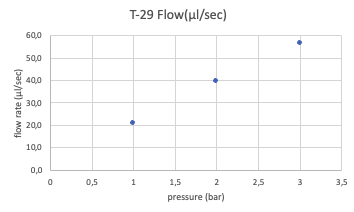
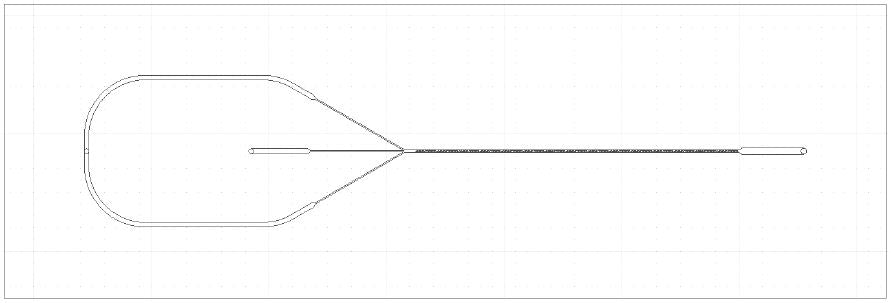
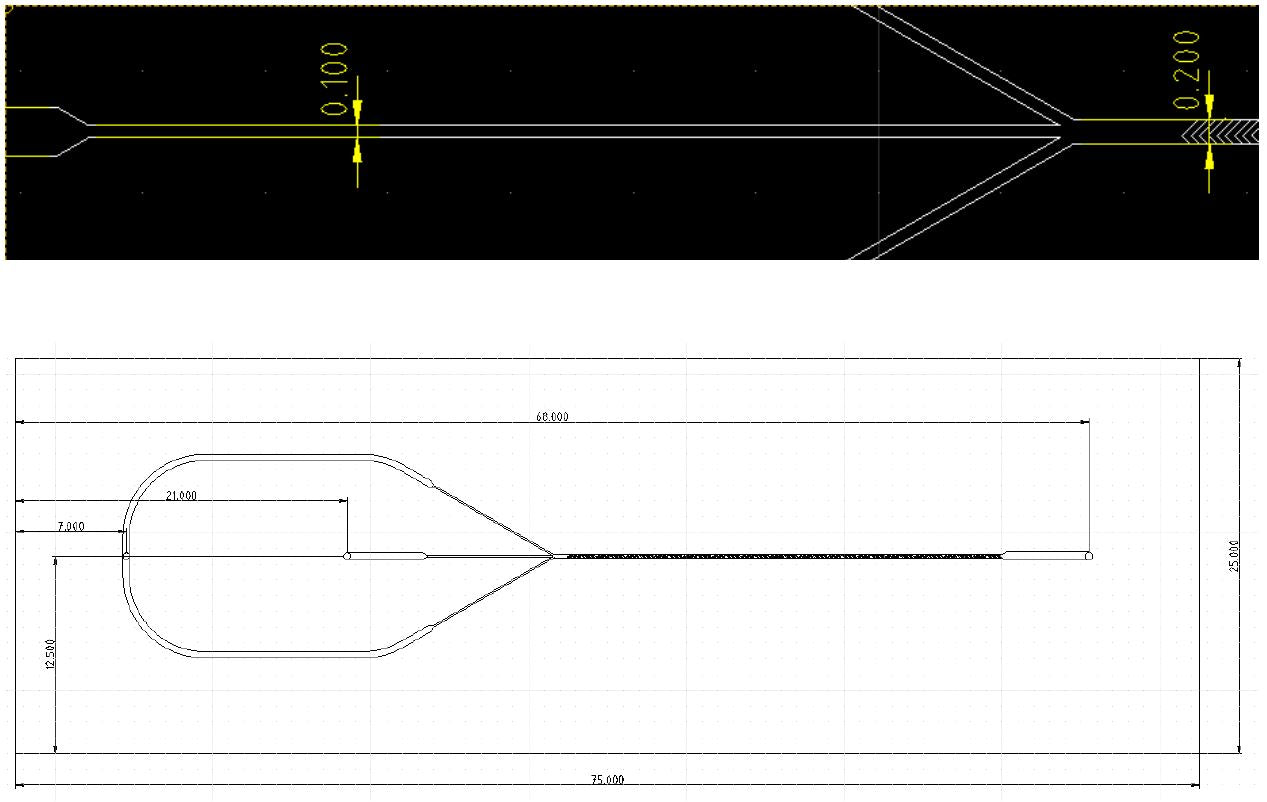
In the mixing section, 6 mixing elements (chevrons) form one block (half cycle), and there are 30 blocks, so there are 15 complete cycles in total. The chip is tested with pressures from 1 to 3 bar, but there are also a few examples of utilization up to 10 bar.
- The two arms of one chevron are 1/3 to 2/3 of the channel dimension (200 µm)
- The distance between the chevrons is 50 µm
- Each mixing element is 50 µm wide and 30 µm high
T-29 Herringbone Mixer
Documentation
Cheung, C., & Al-Jamal, W. T. (2019). Sterically stabilized liposomes production using staggered herringbone micromixer: Effect of lipid composition and PEG-lipid content. International journal of pharmaceutics, 566, 687–696. https://doi.org/10.1016/j.ijpharm.2019.06.033